Kam Edge

Pitch track - Reach! Beyond your feet!

What you get

For Nigerian clubs and academies

The talent was never the problem. The evidence is.

A boy in Lagos and a boy in Lisbon can have the same legs. Only one of them has someone recording it. Your players — first team or academy intake — are judged on a highlight reel and a phone call, while his are judged on numbers, and numbers are what travel. PitchTrack puts a camera on your pitch and turns your own matches into the kind of profile a scout abroad will actually open.

01

Your players get seen without anyone flying in

No scout is getting on a plane for a maybe. That is the whole reason talent here gets missed — not the standard of it. A profile costs a scout nothing to open, and it can reach Madrid, London or the Gulf on the same afternoon you played.

02

When the offer comes, bring evidence

"He's quick" is not a negotiating position. Distance covered, sprint output, top speed, the ground he controls — measured on your pitch, on your date, against the twenty-one other players who were actually on it with him. Numbers you can put in front of a buyer.

03

The record outlives the transfer

A player you developed leaves with his value in someone else's spreadsheet. The account of how he got there stays in yours — and it is what the next fee gets argued against, whether that is a sell-on, a training-compensation claim, or the next boy through your gate who looks exactly like him.

04

Know who is doing the work, and who is getting better

Ninety minutes is more than any touchline can hold. Who really covered the ground, who sprinted when it mattered, who quietly stopped running on the hour — ranked across the squad, match after match. Development stops being a matter of opinion and becomes something you can put in front of a parent, a board, or a buyer.

05

See the shape you are actually playing

You coach a shape on the training ground. This is the one your team plays. How compact you really are, the ground you genuinely control, and where each man drifts when possession turns over — not where the whiteboard says he should be.

06

Nothing for you to run. Nothing leaves your ground.

One fixed camera at the midfield line covers both touchlines. No camera operator, no crew, no internet needed — everything is processed on the device at your ground. No footage goes anywhere without your explicit consent. Your players' data stays your players' data.

Get started

Put your players on record.

One camera at the midfield line is all it takes from you. We handle the rest — the tracking, the analysis, and the profiles that land in front of the people who sign players. Club or academy, your squad on record from your next fixture.

Step one · On the pitch

One mast behind the touchline. That is the install.

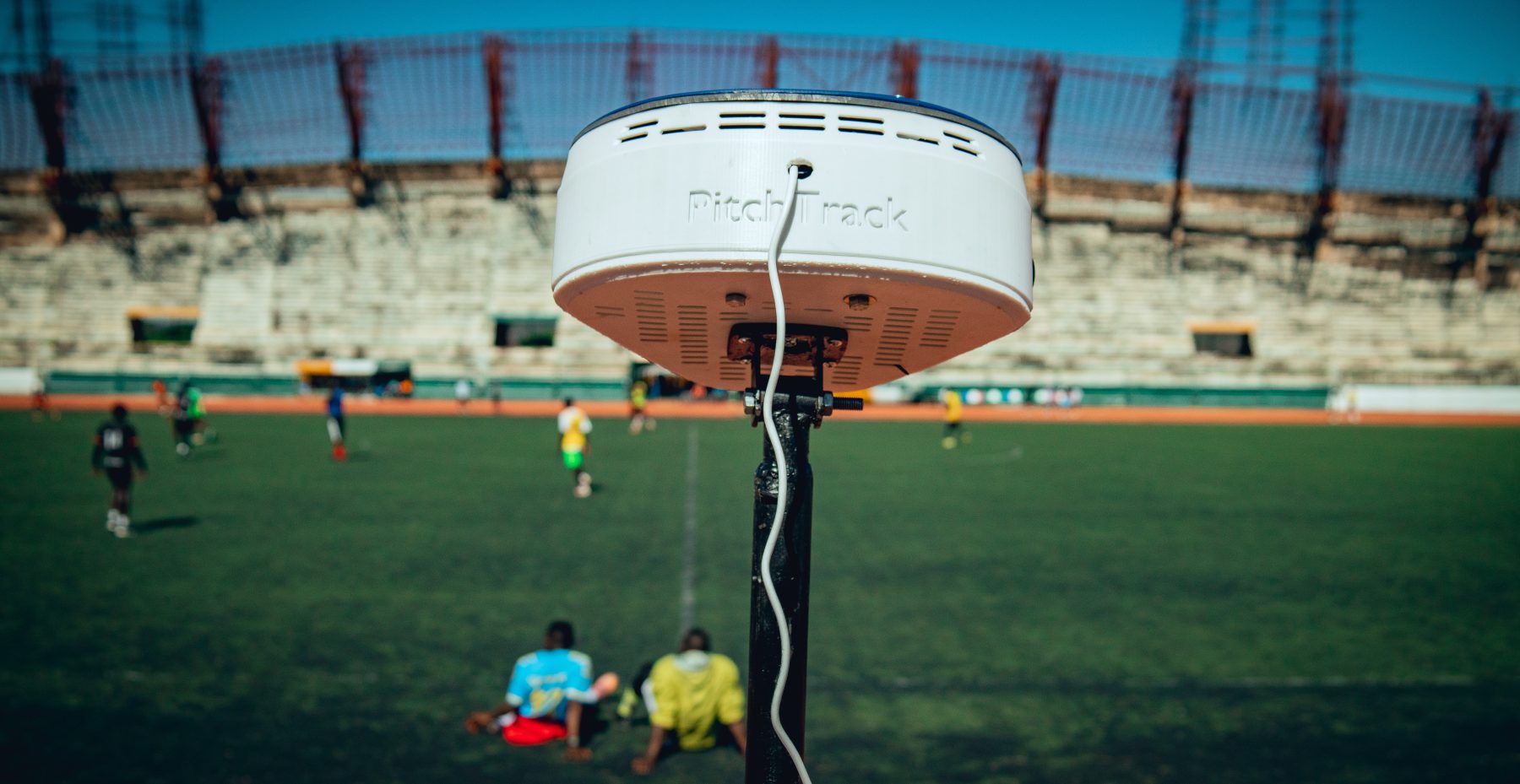
Three lenses in one printed head, on a mast set back from the halfway line. It records the whole match to a card inside the head — nothing worn by your players, nobody walking the touchline with a camera, no connection to anything. It goes up before kick-off and comes down after the whistle.

The PitchTrack head mounted on a mast at the edge of a football pitch, with a match being played behind it.
The head, up and recording. Three fixed lenses cover the pitch between them, so nothing has to pan, follow the ball, or be pointed by anyone.
Wide view of the rig on its mast beside a full match, players on the pitch and substitutes on the touchline behind it.
Set back behind the touchline for a full match — out of the way of the players, the bench and the officials.
Close view of the printed camera head against a clear sky, one lens visible in its front face.
One of the three lenses. Cameras, computer and storage all sit inside the printed shell — there is no second box on the ground.

Step two · In the app

Every player picked out. You put the names on.

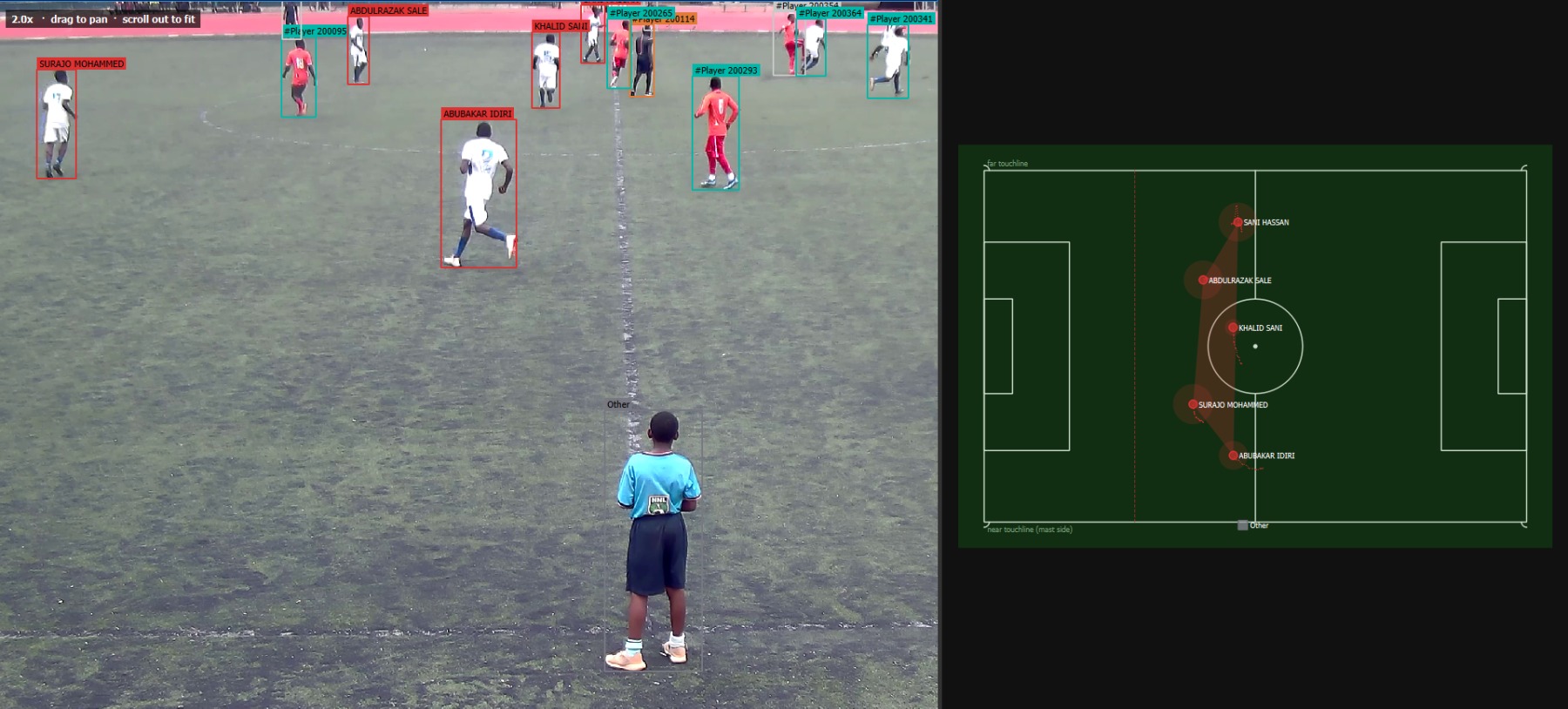
The card comes off the rig and the match plays back with every body on the pitch already found and followed. You type a name onto a shirt — and that player appears on the 2D pitch on the right, with the ground they have covered drawn around them. Anyone on the grass who is not playing is marked as such and left out of the numbers.

PitchTrack running on real match footage: the left panel shows players boxed and followed, four of them named — Surajo Mohammed, Abdulrazak Sale, Khalid Sani, Abubakar Idiri — and the rest still labelled #Player, with a boy in a blue shirt marked Other; the right panel is a top-down green pitch showing those four named players with the ground each has covered shaded around them.
A real match in the app. Left: every body found and followed, four already named, the rest waiting for a name. Right: the same players top-down on the pitch, each with the ground they have covered.
On the video Every player is boxed and followed frame to frame. Click one, type a name, and the label travels with that shirt — and anyone on the grass who is not playing is marked Other and kept out of the figures.
On the 2D map Named players appear top-down on the pitch, so you can read the shape of the game away from the camera angle — the view a scout actually wants.
See it run on your own match footage.

Step three · In the report

Who owned which part of the pitch.

After the match the club gets a report it can read without knowing anything about cameras. This is one page of it: the pitch cut into squares, each tinted toward whichever side spent more of its own match standing there. Every figure is worked out within each side first, so the side the cameras happened to see more of gets no head start from it.

Zone control over a passage of a real match, straight out of the report. Red: the side in red was there more of its own time. Blue: the side in white was. Blank: the cameras did not cover that ground.
What it answers Which side lived in which part of the pitch, how far up each one sat, and when the game turned — measured over every body on the pitch, not a handful of touches logged by hand on the touchline.
What it will not claim A blank square is ground the cameras did not see, not ground nobody ran on. The report puts its own limits in plain words before it puts a single finding.
Read the match report Ajester FA v Gimbiya FA, 2–2 — the report itself, as a club receives it. A tactical edition sits behind it, with the full figures and their margins.
We will run it on a match of yours and send the report back.